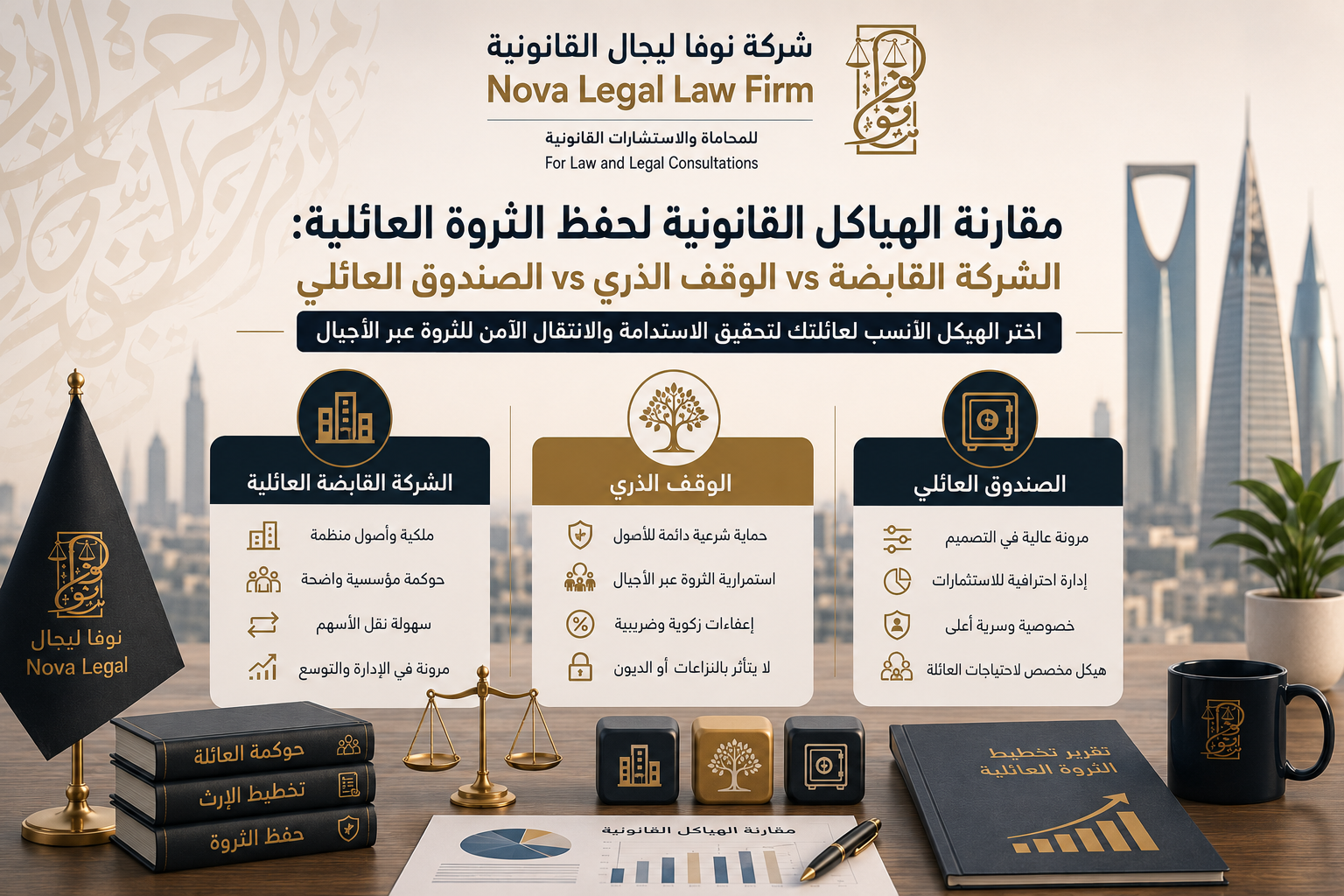
Comparing legal structures for family wealth preservation in Saudi Arabia between the holding company, the family endowment (waqf dhurri), and the family fund is an essential step for any Saudi family seeking to organize, protect, and transfer its wealth across generations in a systematic and secure manner. With growing awareness of the importance of financial and estate planning for families, the need to understand, compare, and select the most appropriate legal option according to each family's circumstances and objectives has emerged. In this comprehensive guide, we provide a detailed comparison of the three main legal structures for family wealth preservation in the Kingdom of Saudi Arabia, with in-depth analysis of the advantages and disadvantages of each structure, the most suitable cases for each, and the legal, tax, and governance implications.
Family wealth represents a legacy that spans generations and requires sophisticated legal tools to preserve it from fragmentation and loss, organize its management and investment, and ensure its transfer to the next generation according to clear and agreed-upon rules. The choice between a holding company, a family endowment, and a family fund is not an easy one. It requires careful analysis of the nature of the wealth, the number of family members, future objectives, and available management capabilities. This guide helps Saudi families make an informed decision about the most appropriate legal structure for preserving their wealth.
This article covers: an overview of each legal structure, comparison in terms of establishment and costs, comparison in terms of governance and management, comparison in terms of tax and zakat implications, comparison in terms of intergenerational wealth transfer, the possibility of combining structures, and frequently asked questions.
Overview of the Three Legal Structures for Family Wealth Preservation
Before delving into the detailed comparison, it is important to understand the basic concept of each of the three legal structures used for family wealth preservation in Saudi Arabia:
The Family Holding Company: A joint stock company or limited liability company that owns shares in other companies (subsidiaries) for the purpose of controlling, managing, and unifying their strategies. In the family context, the family owns the holding company, which in turn owns and manages a group of companies operating in various economic activities. Family members own shares in the holding company in varying proportions, and it is subject to the provisions of the Saudi Companies Law and its implementing regulations. The holding company is managed by a board of directors appointed by the general assembly of shareholders (family members), with responsibilities divided between family management and professional management according to the approved corporate governance structure.
The Family Endowment (Waqf Dhurri): The dedication of an asset (real estate, shares, cash, other assets) and the allocation of its proceeds to the founder's descendants, children, and grandchildren after them, according to specific Sharia and regulatory controls. The family endowment is governed by the provisions of Islamic Sharia, the Saudi Endowments System, and its implementing regulations, and is supervised by the General Authority for Endowments. A trustee (nazir) is appointed (who may be a family member or outsider) to manage the endowment assets, invest them, and distribute their proceeds to the beneficiaries from the founder's descendants according to the founder's conditions. The family endowment is characterized by being a legally independent entity separate from the family members' personal estates, providing strong protection of assets from creditors and disputes.
The Family Fund: A legally independent entity established by a contract or document between family members, aimed at collectively managing and investing family assets according to specific governance rules. The family fund does not have its own independent legal entity status under the Saudi system (unlike some other countries), but it can be established within an appropriate corporate or contractual structure, such as creating a company to manage family assets (Family Office) that functions as a family fund. The family fund is characterized by its flexibility in design and its ability to meet the family's diverse needs, from investment management to estate planning to organizing family governance.
Comparison in Terms of Establishment, Costs, and Regulatory Requirements
Each family wealth preservation structure differs in establishment requirements, costs, and regulatory procedures. The following is a detailed comparison:
| Element | Family Holding Company | Family Endowment (Waqf Dhurri) | Family Fund |
|---|---|---|---|
| Regulatory Procedures | Medium: Company incorporation at Ministry of Commerce, preparation of articles of association, obtaining commercial registration and necessary licenses. Typically takes 2-4 weeks. | Medium to High: Notarization of endowment at Notary Public (endowment deed), registration with the Endowments Authority, appointment of trustee, preparation of regulatory bylaws. Typically takes 4-8 weeks for notarization. | Medium to High: No unified legal structure. Can establish an LLC as a family fund or enter into a contractual agreement between family members with an administrative structure. Requires customized design. |
| Establishment Costs | Medium: Company incorporation fees, lawyer and advisor fees, commercial registration fees. Typically SAR 10,000-50,000. | Low to Medium: Notarization fees (usually nominal), Sharia and legal advisor fees for endowment deed preparation. May reach SAR 20,000-50,000. | Relatively High: High legal and financial advisory fees for designing the appropriate structure, costs of establishing an asset management company. May start at SAR 50,000 and reach SAR 200,000+ for complex structures. |
| Annual Operating Costs | Medium: Accountant and auditor fees, commercial registration renewal fees, administrative and board meeting expenses. | Low: Trustee fees (may be nominal or a percentage of proceeds), minimal administrative expenses. The lowest operating cost structure. | High: Professional management team fees, ongoing legal and advisory expenses, electronic platform and management system costs. The highest operating cost. |
| Regulatory Bodies | Ministry of Commerce, ZATCA, Ministry of Investment (depending on activity). | Endowments Authority, Ministry of Justice (Notary Public), ZATCA. | Ministry of Commerce (if corporate structure), ZATCA. Relatively less government oversight. |
The holding company has the clearest regulatory procedures and lower operating costs after establishment. The family endowment is the least complex in operating costs but requires precise Sharia documentation. The family fund offers the most flexibility but has the highest costs and complexity in design.
Comparison in Terms of Governance and Management
Governance of family wealth preservation structures differs significantly between the three options, and this difference directly affects the family's degree of control over its wealth and flexibility in managing it:
- Family Holding Company: Subject to the provisions of the Saudi Companies Law, meaning a mandatory governance structure including a general assembly of shareholders (family members), an elected board of directors (can include family and non-family members), and specialized committees (audit, nominations and remuneration). The holding company provides clear and familiar institutional governance, with the possibility of separating ownership and management and appointing professional managers. Decision-making procedures are defined in the company's bylaws, reducing ambiguity and disputes. Shareholders have clear legal rights (voting rights, dividend rights, right to sell shares). Ownership structure can be modified relatively easily through transferring or selling shares among family members or to third parties.
- Family Endowment (Waqf Dhurri): Managed by a trustee appointed by the founder (or by competent authorities if none appointed), under the supervision of the Endowments Authority. Endowment governance is subject to the founder's conditions recorded in the endowment deed, which may be flexible or rigid. Generally, there is no general assembly of family members or elected board of directors; the trustee exercises broad powers in managing endowment assets and distributing proceeds according to the founder's conditions. It is very difficult to amend endowment conditions after the founder's death except within a very narrow scope. Family members are merely beneficiaries entitled to proceeds, not owners, meaning their rights to oversee endowment management are limited.
- Family Fund: The most flexible in governance design, as the family can design the management and governance structure to suit its needs. It can include a family general assembly, family council, investment committees, and professional management team. Decisions are governed by the family fund agreement or the bylaws of the company managing family assets. The governance structure can be modified relatively flexibly with family consensus. Allows a high degree of customization in distributing powers and decision-making mechanisms.
The holding company offers clear institutional governance but less customization flexibility. The family endowment offers stable and permanent governance but may be rigid. The family fund offers maximum flexibility but requires strong family agreement and sophisticated administrative structures.
Comparison in Terms of Tax and Zakat Implications
Tax and zakat implications differ significantly among the three legal structures for family wealth preservation and must be considered when selecting the most appropriate structure:
- Family Holding Company: Subject to zakat and tax according to the Saudi Zakat and Tax System. The holding company pays zakat on its zakat base according to established rules (typically 2.5% of the zakat base for Saudi companies). Cash dividends distributed by the company to family shareholders may also be subject to zakat. Donations and operating expenses can be deducted from the zakat base within certain limits. The holding company is obliged to submit annual zakat returns to ZATCA. Subsidiary companies file their returns separately (or consolidated according to consolidated return rules).
- Family Endowment (Waqf Dhurri): Enjoys broader zakat and tax exemptions than the holding company. Endowment assets (the dedicated asset) are not included in the founder's or beneficiaries' zakat base. Proceeds from investing endowment assets may be exempt from zakat if distributed directly to beneficiaries (according to ZATCA interpretations). Commercial activities carried out by the endowment (if exceeding a certain limit) may be subject to zakat. The family endowment is not obliged to pay VAT on charitable, educational, and health activities it conducts (depending on the type and licensing of the activity). The endowment is obliged to submit annual zakat returns to ZATCA.
- Family Fund: Tax and zakat treatment of the family fund depends on the legal structure chosen for its establishment. If established as an LLC, it is subject to the same zakat and tax provisions applicable to companies. If established as a contractual agreement without an independent legal entity, each family member may be subject to zakat on their share individually. The family fund is obliged to submit zakat returns according to the chosen structure. The family fund can benefit from tax exemptions available to non-profit foundations if registered as a non-profit entity and meeting exemption conditions.
The family endowment generally offers the best zakat and tax advantages, followed by the family fund (if appropriately structured), then the holding company which is fully subject to zakat and tax provisions. However, zakat advantages must be balanced with considerations of control, flexibility, and governance when choosing.
Comparison in Terms of Intergenerational Wealth Transfer and Estate Planning
Intergenerational wealth transfer and estate planning are among the most important factors in selecting the appropriate legal structure for family wealth preservation. Each structure has its characteristics in dealing with this vital issue:
- Family Holding Company: Share ownership in the holding company passes to the heirs of a deceased shareholder according to Sharia inheritance rules (for the fixed shares). This means dividing the shareholder's stake among a number of heirs, which may lead to ownership fragmentation across generations. This challenge can be addressed through shareholder agreements regulating voting and company management (such as voting agreements or option agreements), or by structuring the company with different classes of shares (shares with weighted voting rights for the founding generation). The biggest challenge in the holding company is maintaining ownership cohesion as the number of family members increases across generations. Mechanisms such as right of first refusal can help limit the flow of shares to outside parties.
- Family Endowment (Waqf Dhurri): Considered the most powerful tool for intergenerational wealth transfer. The endowed asset remains dedicated and does not enter the founder's estate after death, thus not subject to division under Sharia inheritance rules. The endowment ensures family wealth assets remain cohesive across generations, as they cannot be sold, fragmented, or distributed to heirs. Only the proceeds are distributed to beneficiaries according to the order and conditions specified by the founder in the endowment deed. The founder can determine the order of beneficiaries (children, then grandchildren, then great-grandchildren) and the share of each category, providing flexibility in distributing proceeds across generations. Challenge: the family endowment is permanent and cannot be revoked after the founder's death, meaning future generations will not have the freedom to dispose of assets as they wish.
- Family Fund: Offers high flexibility in estate planning, as rules for ownership transfer, profit distribution, and voting can be designed to suit the family's vision. The fund can include mechanisms to regulate share transfer between generations, such as specifying conditions for fund membership, restricting share transfer to outside parties, and providing liquidity for heirs to purchase shares of those wishing to exit. The fund's rules must comply with Sharia inheritance provisions in Saudi Arabia, which may limit its flexibility compared to family funds in some other countries. The family fund can be combined with a family endowment or will to achieve integrated estate planning objectives.
The family endowment is the strongest in ensuring wealth is not fragmented across generations, but it is the least flexible. The holding company allows division and flexibility but is susceptible to fragmentation. The family fund offers a balance between flexibility and protection. Many Saudi families choose to combine more than one structure to achieve their objectives.
Possibility of Combining Legal Structures
It is not necessary to choose only one structure for family wealth preservation. In fact, many Saudi families choose to combine more than one structure to benefit from the advantages of each and compensate for the disadvantages of others. Common models for combining structures include: holding company + family endowment (where the holding company owns the business assets and the family endowment owns shares in the holding company to benefit from its proceeds for future generations), family fund + family endowment (where the family fund manages investments and distributes profits, and the family endowment represents part of the protected assets), or holding company + family fund (where the holding company is the legal operating entity and the family fund manages family governance and relations with the company). Combining structures increases legal complexity and costs but provides greater protection and flexibility for the family in the long term.
Frequently Asked Questions About Family Wealth Preservation Structures in Saudi Arabia
Below are answers to the most common questions about comparing legal structures for family wealth preservation in Saudi Arabia:
Which structure is best for family wealth preservation in Saudi Arabia?
There is no single ideal structure for all families. The choice depends on wealth size, number of family members, objectives (asset protection, management continuity, income distribution), and required flexibility. Many families choose to combine multiple structures.
What is the main difference between a family endowment and a family holding company?
The family endowment is an independent entity where family members are only entitled to proceeds, while the holding company is owned by family members as shareholders with full ownership rights including voting, share disposal, and profit receipt.
Can a family holding company be converted into a family endowment?
Shares of the holding company can be endowed as a family endowment, but this requires complex regulatory and Sharia procedures and all shareholders' consent, potentially with significant zakat and tax implications.
Is the family fund legally recognized in Saudi Arabia?
There is no specific system for the family fund in Saudi Arabia, but it can be established within a corporate structure (LLC or closed joint stock company) or as a contractual agreement between family members with an appropriate administrative structure.
What are the best practices for intergenerational wealth transfer in Saudi Arabia?
Combining multiple structures, developing a clear family charter, designing shareholder agreements to protect ownership cohesion, preparing the next generation, and engaging specialized legal and financial advisors.
Conclusion: Toward Selecting the Optimal Family Wealth Preservation Structure
Comparing legal structures for family wealth preservation in Saudi Arabia leads to a clear conclusion: there is no one-size-fits-all solution. The choice between a holding company, family endowment, and family fund (or a combination) depends heavily on each family's circumstances, objectives, and vision for the future. The holding company offers clear institutional governance and ease of ownership transfer; the family endowment offers strong asset protection and ensures non-fragmentation across generations; and the family fund offers high flexibility in design and management. The optimal solution for many Saudi families may lie in the strategic combination of these structures to form an integrated framework for preserving, managing, and transferring wealth across generations.
We recommend Saudi families engage specialized legal and financial advisors in estate planning and wealth preservation structures before making any decision, conduct a comprehensive analysis of the family's circumstances and objectives, design an integrated structure taking into account legal, Sharia, tax, and governance aspects, and periodically review and modify the structure as necessary to keep pace with changes in family circumstances and legislation. At Nova Legal for Law and Legal Consulting, we offer specialized services in designing and establishing family wealth preservation structures, including establishing family holding companies, documenting family endowments, designing family funds, and drafting family charters and shareholder agreements. We look forward to accompanying your family on the journey of preserving and building the family legacy for future generations.