
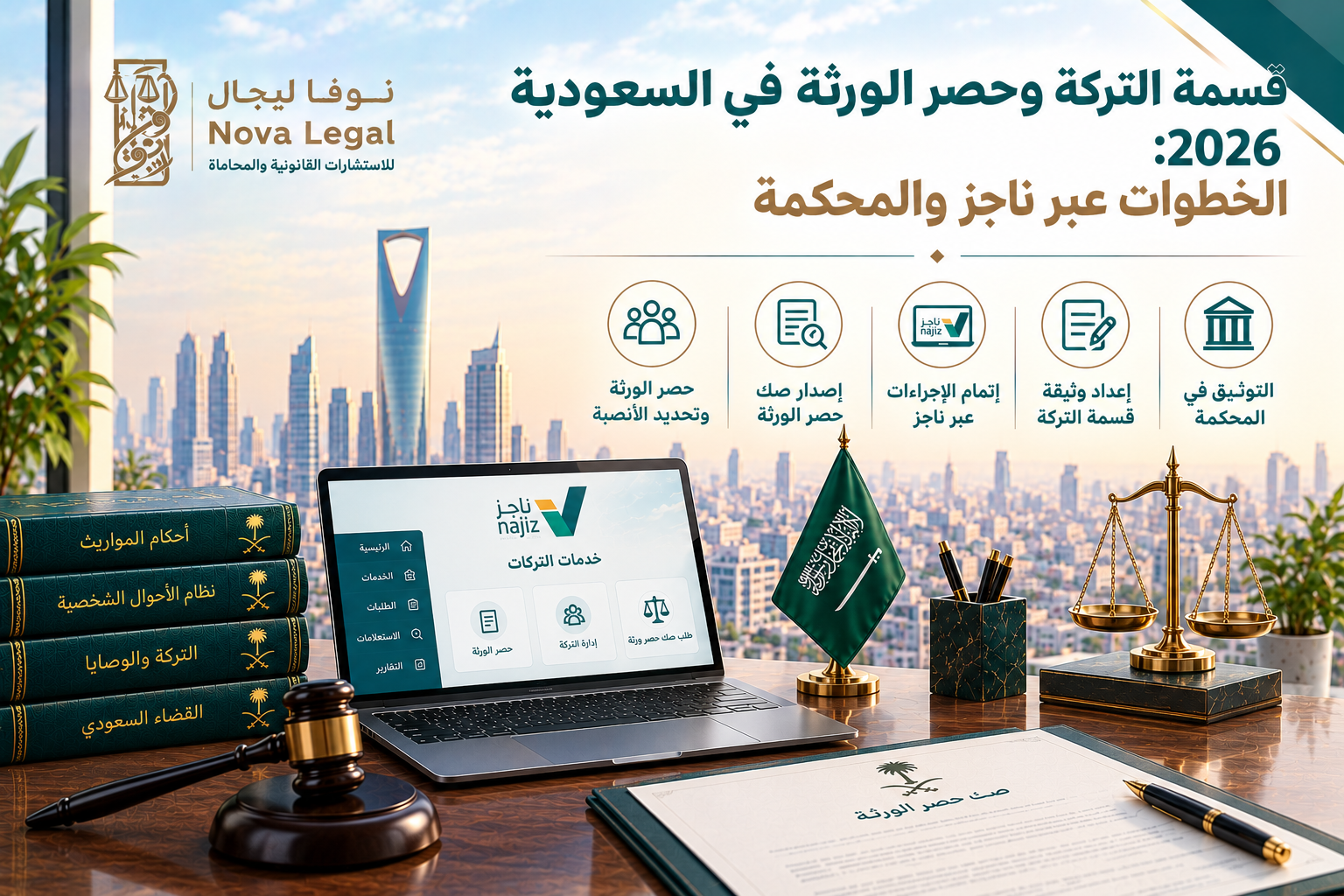
Estate division and heirs certificates in Saudi Arabia: obtaining the heirs certificate on Najiz, the order of claims on the estate, consensual division, court-ordered division before the Personal Status Court, sale of shared assets, and mistakes that delay receiving your share.
After the head of a family dies, the family faces a series of questions: who are the heirs? What are the assets? Are there debts or a will? And how do you divide one property among ten people? In many cases the estate stays frozen for years because one heir refuses to sell, or because the steps were not taken in the right order. Estate division starts with a simple procedure, but its stages need to be understood so it does not turn into a long dispute.
In this guide we explain the steps in order: obtaining the heirs certificate, listing the estate's assets, the order of claims from debts to the will to inheritance, then consensual division between the heirs, and court-ordered division if they disagree.
Step One: The Heirs Certificate
The heirs certificate (sakk hasr al-warathah) is an official document proving a person's death and identifying their lawful heirs. It is the first document banks, government bodies and notaries ask for before any dealing with the deceased's assets. It is obtained electronically on the Najiz platform:
- Log in to Najiz with your National Single Sign-On account.
- Choose "All e-services", then the "Social Status" package.
- Select the "Document Heirs of a Deceased" service.
- Attach the required documents, mainly the death certificate and the heirs' IDs, plus a guardianship deed if any heir is a minor.
- Enter the details of the two witnesses and two character witnesses, who receive messages to confirm their testimony electronically.
- After verification, the certificate is issued electronically and can be downloaded from Najiz.
Any heir, their agent, or a minor's guardian may apply, and not all heirs need to attend. To authorize someone to follow this up, read our guide to documenting a power of attorney on Najiz.
Note: the heirs certificate does not divide the estate; it only identifies who is entitled. Distribution has its own procedures.
Step Two: Listing the Estate's Assets
Before any division, you need an accurate picture of what the deceased left. An estate usually includes:
- Real estate: homes, land and shops, with their title deeds.
- Bank accounts, deposits and investment portfolios.
- Shares and stakes in listed and unlisted companies.
- Valuable movables: cars, gold and equipment.
- Rights against others: debts owed to the deceased, or end-of-service or insurance entitlements.
- Liabilities: debts, loans and guarantees owed by the deceased.
If the deceased was a partner in a family company, their stake is part of the estate, and the company's articles may contain special rules on the transfer of shares. For more detail, read about resolving family disputes in companies.
The Order of Claims on the Estate: From Debts to Inheritance
The estate is not divided among the heirs directly; claims are paid from it in this order:
| Order | Claim | Note |
|---|---|---|
| 1 | Funeral expenses | Reasonable, without extravagance |
| 2 | Debts | Paid before the will and inheritance |
| 3 | Will | Within one-third; any excess needs the heirs' approval |
| 4 | Inheritance | The remainder is divided according to Sharia shares |
To calculate shares, you can use the inheritance calculator on the Ministry of Justice portal, and review the result in complex cases. If the deceased left a will, read about its rules in our guide to writing and documenting a will in Saudi Arabia.
Consensual Division: The Fastest Route
If all heirs agree on how to distribute the estate, consensual division is the fastest and least costly route. It can take several forms:
- Division in kind: each heir takes a property or asset equal to their share.
- Selling assets and distributing the proceeds according to shares.
- Buy-out (takharuj): an heir gives up their share in a particular asset in return for money or another asset.
- Keeping assets jointly and managing them through an agreement, a company or a family fund.
The agreement is documented officially through the Ministry of Justice's e-services or a notary, so that ownership of real estate and assets can be transferred under it. The agreement should be precisely written, with a fair valuation of the assets, and with the approval of a minor's guardian under the proper procedures if any heir is a minor.
Court-Ordered Division: When an Heir Refuses
If an heir refuses to divide or sell, or obstructs the process, any heir may file a division lawsuit before the Personal Status Court through Najiz. The case usually goes through these stages:
- Filing the case with the heirs certificate, a statement of the estate's assets and the point of dispute.
- Inventory and valuation through the court, which may appoint accredited experts or valuers.
- Division in kind where the assets can be divided without harm.
- Sale of assets that cannot be divided, such as a single house among several heirs, usually by auction, with the proceeds distributed according to shares.
The Center for Support and Liquidation (Infath) handles the sale of many assets through auctions in cases referred to it. A judgment in a division case can be appealed within the statutory periods, as explained in our guide to appealing a judgment in Saudi Arabia.
Helpfully, the Judicial Costs Law exempts estate division cases from judicial costs, although other costs such as valuation and legal fees still apply.
Mistakes That Delay Estate Division for Years
- Delaying the heirs certificate, so accounts stay frozen.
- One heir dealing with an asset before division without the others' consent.
- Overlooking debts or the will before distribution, then a creditor claims later.
- A verbal agreement between heirs without documentation, then one backs out.
- Ignoring minors' rights and the guardianship procedures for them.
- An unfair valuation of assets that leaves some heirs feeling wronged.
- Leaving the family company unorganized after the founder's death, so its management stalls.
Large Estates and Family Businesses
When an estate includes companies, investment portfolios or multiple properties, dividing it asset by asset may destroy its value. Families then look for structures that preserve wealth and distribute returns instead of breaking up assets, such as a family holding company, a family fund or a family waqf.
Read our guide to the family fund and protecting family wealth across generations, and our comparison of legal structures for family wealth preservation.
When Do You Need a Lawyer for Estate Division?
- When there is a dispute between heirs over division, valuation or sale.
- When there are minors or heirs outside the Kingdom.
- When the estate includes companies or multiple assets in more than one city.
- When there is a disputed will or unclear debts.
- For representation in division cases and disputes between heirs, see our litigation and dispute resolution service.
- To organize wills and waqfs before or after division, see our endowments and wills service.
- To assess the estate and the right next step, book an in-office legal consultation.
Frequently Asked Questions
How do I obtain an heirs certificate on Najiz?
Log in to Najiz with your National Single Sign-On account, go to all e-services, then the Social Status package, then the "Document Heirs of a Deceased" service, attach the death certificate and heirs' IDs, have the witnesses and character witnesses confirm electronically, and the certificate is issued and can be downloaded from Najiz.
Does the heirs certificate divide the estate?
No. The heirs certificate proves the death and identifies the lawful heirs only. Distribution happens through consensual division between the heirs, or through court-ordered division if they disagree.
What is the correct order for distributing an estate?
First the funeral expenses, then the deceased's debts, then the will within one-third, and the remainder is divided among the heirs according to their Sharia shares.
What can I do if one heir refuses to divide the estate?
Any heir can file a division lawsuit before the Personal Status Court through Najiz. The court may order the sale of assets that cannot be divided, usually by auction, and distribute the proceeds according to the heirs' shares.
Are there judicial costs on an estate division lawsuit?
Under the Judicial Costs Law, estate division cases are exempt from judicial costs, although other costs may apply, such as legal fees, valuation or auction fees.
An estate stuck between heirs? We start with the right step
We obtain the heirs certificate, list the estate, draft the consensual division agreement, and represent you in a division case before the court if the heirs disagree.
info@novalegal.sa | Al Sahaba Road, Al-Ishbiliyah District, Riyadh
Conclusion: Estate Division Starts with the Right Order
Estate division goes through clear stages: the heirs certificate, listing the assets, paying debts and carrying out the will, then distribution by agreement or through the court. Following this order and documenting every agreement is what saves years of dispute and preserves family relationships.
The Nova Legal team in Riyadh supports heirs at every stage of an estate, from the first procedures to division and representation in court, through our litigation and dispute resolution service. Address: Al Sahaba Road, Al-Ishbiliyah District, Riyadh – Building 2/2 Al Hamra City, Second Floor, Office 202.