
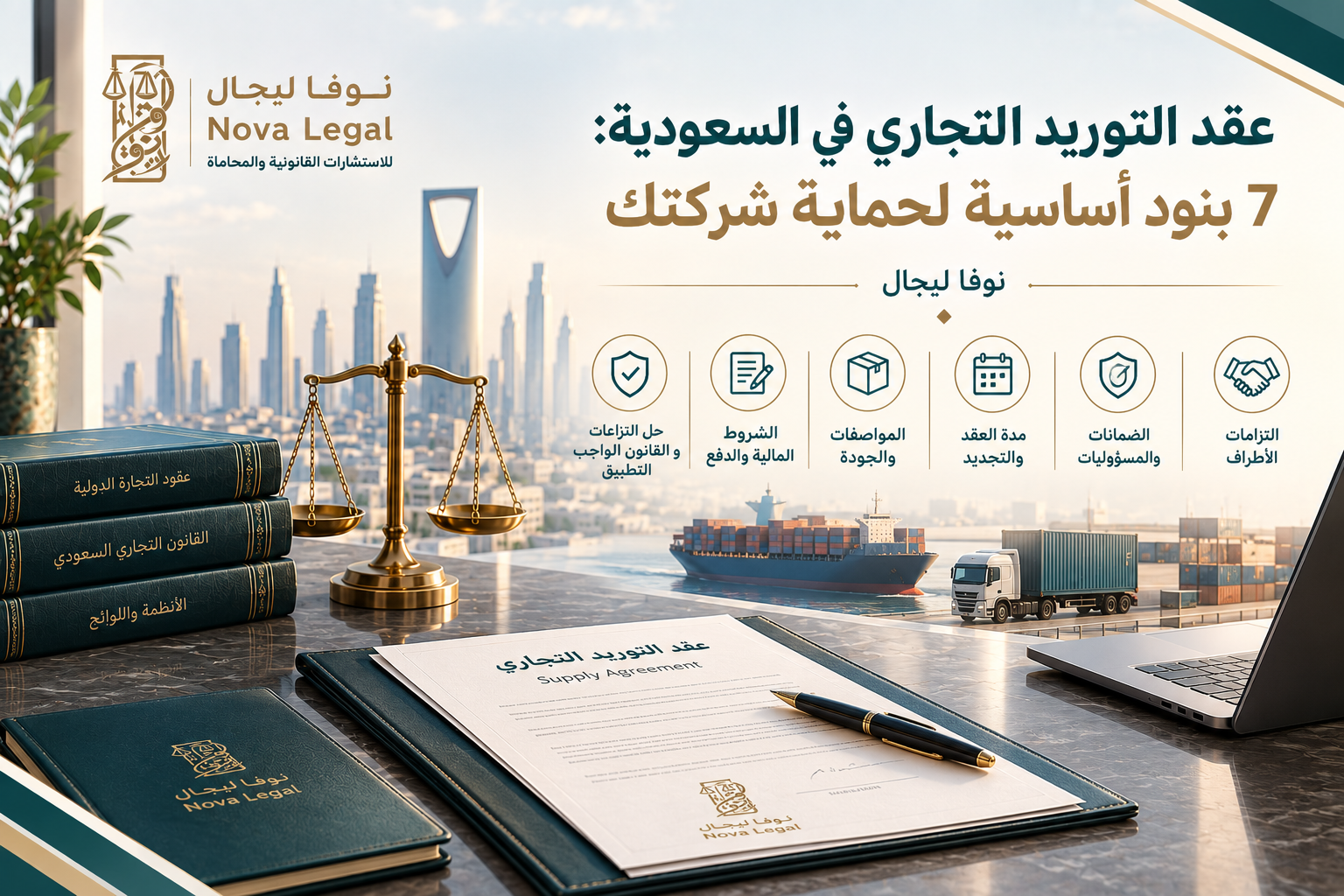
Nova Legal, a Riyadh-based law firm, advises businesses on drafting and reviewing supply agreements in Saudi Arabia. Our commercial contracts team helps define the goods, specifications, pricing, delivery obligations, risk allocation, and dispute-resolution mechanisms that protect both parties.
Every growing business depends on a reliable supply chain. A supply agreement is the document that governs that relationship. Whether you are a supplier delivering goods on a recurring basis or a buyer relying on a steady flow of products, the contract should clearly allocate responsibility for delays, defective or non-conforming goods, payment issues, and other commercial risks.
In this guide, Nova Legal explains the practical legal and commercial issues behind a supply agreement in Saudi Arabia. It covers the distinction between a supply agreement and a sale contract, seven essential clauses, the structure of a Saudi goods supply contract template, and key safeguards when contracting with a Chinese manufacturer. To learn more about our services, visit contract drafting, preparation, and review.
Supply Agreement vs. Sale Contract in Saudi Arabia
Saudi laws do not provide a separate statutory definition of a supply agreement. Depending on its structure, a supply arrangement may involve recurring sales, a framework agreement for future purchase orders, a manufacturing and supply arrangement, or continuing and exclusive obligations such as minimum-purchase commitments. For that reason, a goods supply agreement is often analysed in light of the sale provisions and general rules of obligations under the Saudi Civil Transactions Law, issued by Royal Decree No. M/191 dated 29/11/1444 AH and Council of Ministers Resolution No. 820. The Law entered into force after 180 days from its publication, subject to the wording of the Law and any applicable commercial or sector-specific legislation. The full text is available through the Bureau of Experts at the Council of Ministers.
A supply agreement may overlap with a sale contract because both can involve the transfer of title to goods. The practical difference is that a supply agreement usually governs multiple deliveries, purchase orders, forecasts, and continuing obligations over a defined period. Its legal character may vary according to the wording of the agreement, the goods, the parties’ obligations, and the duration of the relationship. For additional guidance, see our article on the fundamentals of commercial contract drafting in Saudi Arabia.
Under the Civil Transactions Law, title to the sold item generally passes to the buyer upon conclusion of the sale, without prejudice to the relevant statutory provisions, including Articles 655, 656, and 657. That rule should not be treated as an automatic answer for every commercial transaction. The parties may consider a retention-of-title arrangement until payment, some assets may be subject to registration requirements, and the transfer of title may differ from the transfer of risk for loss or damage under the agreed delivery terms. A sale of a specifically identified item that the seller does not own may also be ineffective against the owner unless the owner approves it.
| Comparison point | Sale contract | Supply agreement |
|---|---|---|
| Core obligation | Transfer of title to identified goods for a price | Recurring deliveries of agreed quantities over a period |
| Quantities | Usually fixed at the outset | May be set by forecasts, schedules, or purchase orders |
| Delivery | Usually a single delivery | Successive shipments during the contract term |
| Typical legal impact | Primarily governed by the sale terms and applicable law | Strongly affected by the drafting, goods, and continuing obligations |
7 Essential Clauses in a Commercial Supply Agreement
The seven clauses below are not merely standard wording. Their value depends on how precisely they address the commercial relationship and the disputes most likely to arise.
- Goods, specifications, and quantities: Identify the goods by type, technical description, quality standards, packaging, and quantity. State whether forecasts and schedules are binding or indicative, and connect deliveries to purchase orders or mandatory schedules. Where appropriate, define minimum and maximum quantities to avoid uncertainty about the parties’ commitments.
- Price, currency, and payment terms: State the unit price, pricing basis, currency, payment schedule, invoicing requirements, and consequences of late payment. A well-drafted agreement should also explain whether and how prices may change when raw-material costs, freight charges, or exchange rates change. Ambiguity about currency can create a separate dispute over the value of the payment obligation.
- Delivery, shipping, and allocation of risk: Specify the delivery location, transport arrangements, insurance responsibility, and the point at which the risk of loss or damage moves from one party to the other. The agreement should also state when title passes and make clear that the transfer of title does not necessarily coincide with the transfer of delivery risk.
- Inspection, acceptance, and warranties: Distinguish hidden defects, non-conformity with specifications, and commercial warranties. Set an inspection period, notice procedure, rejection rights, repair or replacement obligations, and the effect of failing to notify or using goods after a defect is discovered. For food, pharmaceutical, and industrial products, include product-safety, recall, and regulatory-compliance procedures.
- Delivery schedules and contractual remedies: Set delivery dates, notice requirements, and the consequences of delay. Contractual penalties and agreed damages should be drafted with regard to the expected loss, applicable legal restrictions, and the authority of the competent body to assess the effect of the clause in a dispute. Any liability cap should be used only where legally permissible and should be drafted with appropriate exclusions.
- Force majeure and termination: Address events such as transport disruption, embargoes, disasters, and government restrictions in express terms. The clause should explain their effect on performance, notice obligations, suspension rights, and termination. It should also address outstanding purchase orders, unpaid amounts, warranties, confidentiality, and other obligations that survive termination.
- Confidentiality, intellectual property, and general terms: Protect business information and identify ownership of moulds, tools, drawings, specifications, and designs where goods are manufactured to the buyer’s design. Regulate assignment and subcontracting, notices and approved communication channels, the governing law, and the chosen dispute-resolution mechanism.
Structure of a Saudi Goods Supply Contract Template
A business looking for a Saudi supply contract template usually needs more than a blank form. It needs a practical structure that can be adapted to the goods, industry, delivery model, and payment arrangement. A balanced commercial supply contract commonly includes the following sections:
- Party details, legal status, contact information, definitions, and the scope of supply.
- Description of the goods, quantities, technical specifications, and binding schedules or annexes.
- Prices, currency, invoicing, payment deadlines, and price-adjustment mechanisms.
- Delivery terms, insurance, shipping arrangements, and allocation of risk at each stage.
- Inspection, acceptance, warranties, and procedures for defective or non-conforming goods.
- Delivery schedules, contractual remedies, and force-majeure procedures.
- Confidentiality, intellectual property, assignment, and subcontracting controls.
- Governing law, dispute resolution, notices, and signature page.
For example, a quantity clause might state: “The supplier shall deliver 5,000 units of Product S in four monthly shipments in accordance with the technical specifications attached as Schedule 1.” This structure is for general guidance and does not replace legal review. Nova Legal can adapt it to your business through our supply contract drafting service.
Negotiating a supply agreement with a supplier or buyer?
Speak with Nova Legal’s commercial contracts lawyers in Riyadh before signing the agreement or paying an advance.
Supply Contract with a Chinese Manufacturer: Key Safeguards
Buying from a Chinese manufacturer introduces cross-border risks in addition to the issues covered above. A well-structured international supply contract should address the following points:
- Verify the manufacturer’s identity: Check the company’s legal name, business licence, registration information, and official details. Confirm whether the counterparty is the actual manufacturer or a trading intermediary without its own production line.
- Specifications, samples, and acceptance: Approve technical specifications and pre-production samples. Define inspection rights before shipment and after arrival, together with the consequences of non-conformity.
- Shipping and delivery terms: Use the ICC Incoterms rules to allocate delivery tasks, costs, and transport risk. Incoterms do not usually determine title to the goods, governing law, or dispute resolution, so those matters must be addressed separately in the contract.
- Documents, labelling, and customs: Allocate responsibility for certificates of origin, customs documents, packaging, and labelling that comply with Saudi requirements. State who bears the risk of delays at ports, during customs clearance, or in transit.
- Intellectual property: Identify ownership and control of moulds, tools, drawings, product designs, and technical documentation when the goods are manufactured to the buyer’s specifications. Prohibit a change of manufacturer or unauthorised subcontracting without written consent.
- Payment security: Regulate the advance payment, payment instruments, security arrangements, and the procedure for claiming repayment or activating security if the manufacturer fails to perform.
- Language and governing law: Identify the controlling language if the Arabic, English, and Chinese versions differ. Name the governing law expressly instead of leaving the issue to later interpretation.
- Dispute resolution: Arbitration may be appropriate for some international supply contracts. If selected, specify the seat, institution or procedural rules, language, governing law, and how the award is expected to be enforced in the relevant country. Arbitration is not automatically better than court litigation.
In addition to contract drafting, Nova Legal provides a business partnership service for companies working with Chinese partners, supporting a more secure legal and investment environment for both sides.
Send us your transaction details or current supply contract for legal review.
Nova Legal’s commercial contracts team will identify key clauses and material risks before you commit.
Al Sahaba Road, Ishbiliyah, Riyadh – Building 2/2, Al Hamra City, 2nd Floor, Office 202 | info@novalegal.sa
Frequently Asked Questions About Supply Agreements
Is a supply agreement a sale contract under Saudi law?
Saudi laws do not provide a separate statutory definition of a supply agreement. Goods supply arrangements are often analysed in light of the sale provisions and general rules of obligations under the Saudi Civil Transactions Law, depending on the contract’s wording, the goods, the parties’ obligations, and any applicable commercial or sector-specific legislation.
What is the difference between a supply agreement and a sale contract?
They may both involve the transfer of title to goods. A supply agreement usually governs recurring deliveries, purchase orders, and continuing obligations over a defined term. Its legal character depends on the agreement’s wording, the goods, and the parties’ actual obligations.
What clauses should a Saudi supply contract include?
The contract should address the goods and quantities; specifications and acceptance; price, currency, payment, and price adjustments; delivery and allocation of risk; warranties and non-conformity; schedules and contractual remedies; force majeure and termination; confidentiality and intellectual property; and governing law and dispute resolution.
Is a standard Saudi supply contract template enough?
A template is a starting point, not a substitute for legal review. The final supply agreement should reflect the parties’ legal details, commercial registration information, tax treatment, payment structure, delivery location, product requirements, and applicable sector rules.
How can I contract safely with a Chinese manufacturer?
Verify the manufacturer’s identity, approve specifications and samples, define inspections and customs documents, protect intellectual property, regulate advance payments and security, choose the controlling language and governing law, and specify the seat, rules, language, and enforcement framework if arbitration is selected.
Conclusion: A Supply Agreement Protects Your Business
A supply agreement is not merely an administrative document. It is the contractual framework that protects margins, supports supply-chain continuity, and allocates responsibility when performance does not go as planned. The difference between an agreement that clearly addresses the goods, specifications, payment, delivery, quality, and remedies and a generic form copied from the internet can determine whether a problem is resolved commercially or develops into a prolonged dispute.
Nova Legal drafts supply agreements in Saudi Arabia and reviews existing supply contracts before hidden risks affect your business. Contact our team to review your current agreement or prepare a new contract for a domestic or international supply relationship.
References
- Saudi Civil Transactions Law – Royal Decree No. M/191 and the official text published by the Bureau of Experts at the Council of Ministers: official text.
- International Chamber of Commerce, Incoterms rules.
This article is provided for general information only and does not constitute legal advice for a specific matter. The legal and commercial risks may vary depending on the goods, transaction value, place of performance, status of the parties, and applicable sector-specific requirements.