
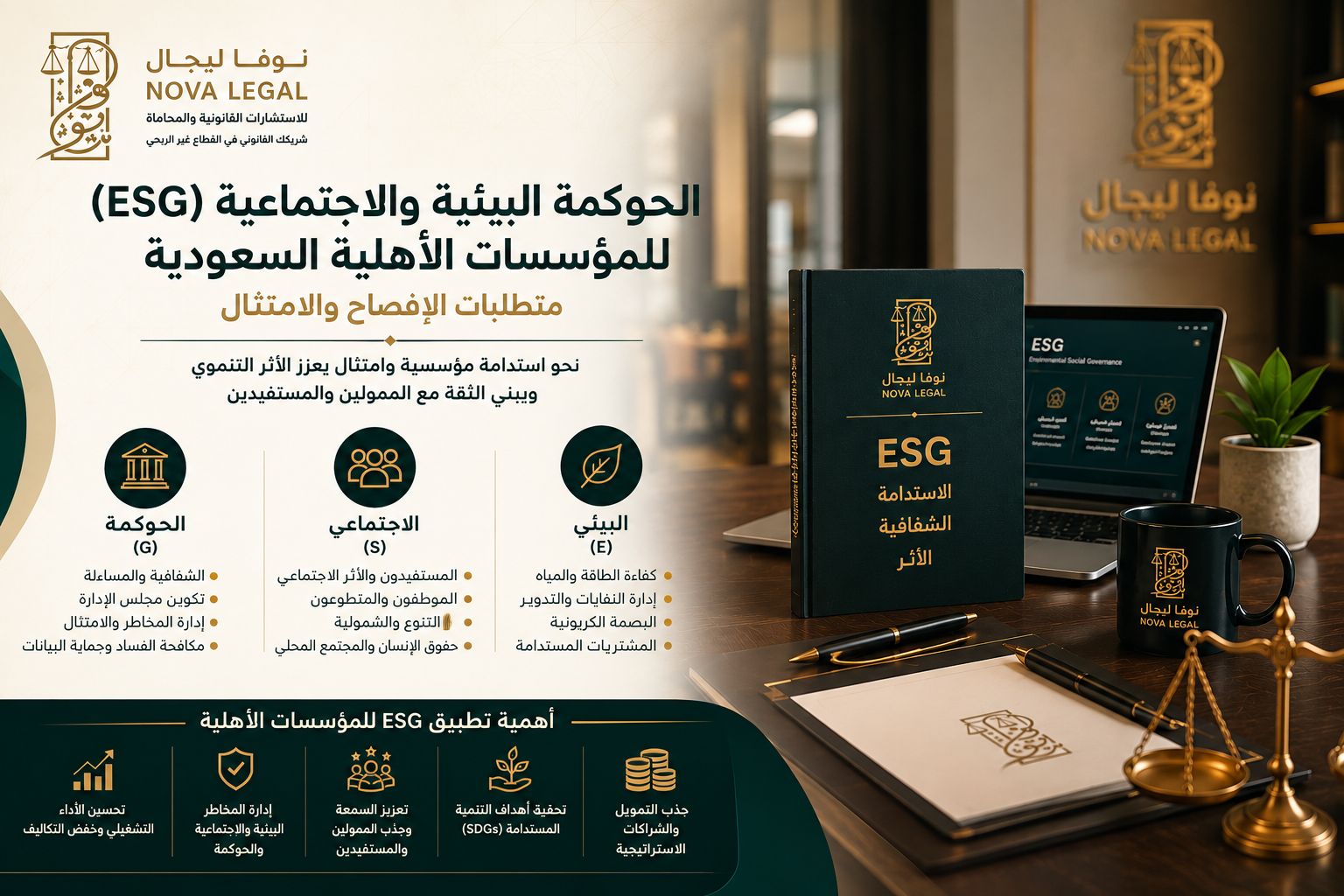
Environmental, Social, and Governance (ESG) for Saudi non-profit foundations has become a fundamental standard for measuring institutional performance, evaluating impact, attracting funding, and building reputation in the modern era. ESG is not a passing trend or an additional reporting requirement; it is an integrated strategic framework that helps non-profit foundations achieve their developmental objectives in sustainable and responsible ways, enhancing the trust of funders, regulators, and beneficiaries. In this comprehensive guide, we examine in detail the disclosure and compliance requirements for ESG in Saudi non-profit foundations.
The world is witnessing a significant shift toward sustainability, social responsibility, and governance transparency, and the Kingdom of Saudi Arabia is no exception to this trend. With the launch of Vision 2030 and its ambitious initiatives in the fields of environment, social responsibility, and governance, non-profit foundations are increasingly expected to adopt ESG standards in their operations and reporting. Non-profit foundations that embrace ESG not only contribute to achieving sustainable development goals but also enhance their ability to attract funding and partnerships, improve their reputation, and reduce operational and reputational risks.
This article covers: the concept of ESG and its importance for Saudi non-profit foundations, the environmental dimension, the social dimension, governance, disclosure frameworks and standards, integrating ESG into strategy, preparing sustainability reports, and frequently asked questions about ESG in the Saudi non-profit sector.
Concept of ESG and Its Importance for Saudi Non-Profit Foundations
ESG in Saudi non-profit foundations is an integrated framework for evaluating institutional performance in three main areas: Environmental: covering the impact of the foundation's activities on the environment such as energy and water consumption, waste management, and carbon footprint; Social: covering the foundation's relationship with employees, volunteers, beneficiaries, and the community as a whole, including labor practices, diversity, human rights, and social impact; and Governance: covering governance practices, transparency, accountability, anti-corruption, and data protection. In the non-profit sector, ESG takes on an additional dimension related to the foundation's commitment to its developmental mission and achieving measurable positive social impact.
The importance of ESG for Saudi non-profit foundations is multifaceted: attracting funding and grants (local and international funders increasingly prioritize ESG criteria in funding decisions); enhancing reputation and credibility (foundations committed to ESG standards enjoy better reputation and higher trust from the community and beneficiaries); improving operational performance (applying ESG practices reduces operational costs and improves resource efficiency); risk management (the ESG framework helps identify and manage environmental, social, and governance risks before they escalate); attracting talent and volunteers (the new generation of employees and volunteers prefers working with institutions that embrace strong sustainability and responsibility values); and compliance with future regulatory requirements (regulators are expected to impose increasing ESG disclosure requirements on the non-profit sector in the near future).
The Environmental Dimension of ESG for Saudi Non-Profit Foundations
The Environmental dimension (E) of ESG focuses on the impact of the non-profit foundation's activities on the environment and its contribution to achieving environmental sustainability goals in the Kingdom. Some non-profit foundations may think their environmental impact is limited because they are not industrial companies, but the reality is that all foundations leave an environmental footprint through energy and water consumption, waste production, employee travel, and event organization.
Key focus areas in the environmental dimension for non-profit foundations include: energy efficiency (measuring energy consumption in the foundation's buildings and identifying opportunities for conservation and transition to renewable energy sources such as solar power); water management (rationalizing water consumption and implementing recycling practices where possible); waste management (implementing recycling practices, reducing plastic and paper waste, and responsibly managing electronic waste); carbon footprint (measuring carbon emissions associated with the foundation's activities, travel, and events, and developing a reduction plan); sustainable procurement (preferring suppliers that apply sustainable practices and reducing reliance on non-recyclable materials); and environmental awareness (incorporating environmental awareness into the foundation's programs and awareness messaging to beneficiaries). Implementing good environmental practices not only reduces environmental impact but also lowers the foundation's operational costs in the long term.
The Social Dimension of ESG for Saudi Non-Profit Foundations
The Social dimension (S) of ESG is the most important and natural for non-profit foundations, as their core mission is to achieve positive social impact. This dimension focuses on the foundation's relationship with its employees, volunteers, beneficiaries, and the community as a whole. Key focus areas in the social dimension include:
- Beneficiaries: Systematically measuring the social impact of programs on beneficiaries, ensuring services reach the most needy groups, implementing feedback and complaint mechanisms, and protecting beneficiaries' rights and dignity with prompt and transparent complaint handling.
- Employees and Volunteers: Applying fair labor practices including appropriate wages, reasonable working hours, and safe working conditions; providing continuous development and training opportunities; promoting diversity and inclusion in the workplace (including empowering persons with disabilities); and establishing clear policies against discrimination and harassment.
- Community: Consulting with the local community about its needs and priorities before designing programs; contributing to local development and job creation; transparency in dealing with the community and disclosing activities and impact; and building partnerships with local community institutions to enhance shared impact.
- Human Rights: Ensuring that all foundation programs, activities, and supply chains respect human rights, and establishing policies prohibiting child labor and forced labor in any of the foundation's activities or with its suppliers.
- Health and Safety: Applying occupational health and safety standards in the foundation's premises and program sites; providing appropriate health insurance for employees; and establishing emergency and safety protocols for events and field programs.
Non-profit foundations that excel in the social dimension are those that place the beneficiary at the heart of their focus, measure their real impact on beneficiaries' lives and not just program outputs, and ensure that all internal practices reflect the values they advocate in their external programs.
Governance as an ESG Dimension for the Non-Profit Sector
Governance (G) is the third pillar of the ESG framework, focusing on how the foundation is managed, supervised, and how decisions are made, ensuring transparency and accountability. In the non-profit sector, governance is not merely compliance with regulatory requirements but a reflection of the foundation's commitment to integrity, transparency, and responsibility toward funders, beneficiaries, and the community. Key focus areas in governance for non-profit foundations include: board composition, diversity, and independence; transparency of decision-making processes and their documentation; anti-corruption and bribery policies; whistleblower protection; information security and personal data protection; and compliance with all relevant regulations and legislation. Good governance disclosure includes publishing information about the board and its members, applied governance policies, board performance evaluation, key risks and their treatment measures, and ownership and shareholder structure (if any). In non-profit foundations, ESG governance also means ensuring that internal governance practices support the achievement of the foundation's developmental mission and do not constitute an obstacle to innovation and flexibility.
ESG Disclosure Frameworks and Standards for Non-Profit Foundations
ESG disclosure frameworks and standards provide standardized methodologies for preparing sustainability reports and disclosing environmental, social, and governance performance. Key global frameworks that Saudi non-profit foundations can reference include: the Global Reporting Initiative (GRI) — the most widely used global framework for sustainability reporting, providing specific standards for disclosing economic, environmental, and social performance; the Sustainability Accounting Standards Board (SASB) — focusing on disclosure of material sector-specific information; the Task Force on Climate-related Financial Disclosures (TCFD) — focusing on disclosure of climate-related risks and opportunities; and the UN Sustainable Development Goals (SDGs) — providing a framework for linking the foundation's activities to global sustainable development goals. At the local level, Saudi non-profit foundations can benefit from Vision 2030 initiatives in the areas of environment, social responsibility, and governance as a reference for determining disclosure priorities, in addition to the National Center for Non-Profit Sector Development's requirements in periodic reports.
We recommend non-profit foundations start with GRI standards as a basic framework for preparing ESG reports, given its comprehensiveness and suitability for the non-profit sector. The foundation can select a set of standards appropriate to the nature of its activity, size, and the most material topics for the foundation and its stakeholders. The goal is not to prepare a massive report covering everything, but a focused and transparent report concentrating on the topics most important to the foundation and its stakeholders.
Steps for Integrating ESG into a Non-Profit Foundation's Strategy
Integrating ESG into the strategy of a Saudi non-profit foundation requires following systematic steps to ensure that ESG is not merely a superficial addition but an integral part of the foundation's identity and operations. Key steps include:
- Materiality Assessment: Identifying ESG topics most important to the foundation and its stakeholders (funders, beneficiaries, employees, regulators) through surveys, workshops, and interviews. The result is a materiality matrix determining ESG priorities for the foundation.
- Setting Commitments and Targets: Based on the materiality assessment, the foundation defines its commitments in key ESG areas and sets specific, measurable, time-bound (SMART) targets. Examples: "Reduce energy consumption by 20% by 2028," "Increase beneficiary satisfaction rate to 90%," "Implement an integrated governance policy approved by the board."
- Integrating ESG into Policies and Procedures: Embedding ESG commitments into the foundation's policies and operational procedures, such as sustainable procurement policy, human resources policy (diversity and inclusion), risk management policy (including ESG risks), and code of professional conduct.
- Capacity Building: Training foundation staff and board members on ESG concepts, disclosure frameworks, and measurement mechanisms. Building internal capacity is a prerequisite for successfully integrating ESG into the foundation's culture.
- Measurement and Data Collection: Establishing a system for periodically and regularly collecting data on ESG indicators. This may require developing new tools or modifying existing ones to capture required data.
- Preparing ESG Reports: Preparing periodic reports on ESG performance (at least annually) according to a recognized international framework (such as GRI). The report should be honest and transparent, including both achievements and challenges.
- Review and Continuous Improvement: Reviewing ESG performance annually, evaluating progress toward targets, and updating the materiality assessment and ESG targets based on lessons learned and changes in the foundation's operating environment.
Integrating ESG is not a one-time project but a continuous improvement journey requiring long-term commitment and investment in capabilities and systems. Foundations that succeed in this journey reap significant benefits in reputation, funding, performance, and impact.
Frequently Asked Questions About ESG in Saudi Non-Profit Foundations
Below are answers to the most common questions about ESG in Saudi non-profit foundations:
What is the difference between ESG and CSR?
ESG is a more comprehensive and measurable framework than CSR, focusing on three specific dimensions with measurable performance indicators and regular reporting.
Is ESG mandatory for non-profit foundations in Saudi Arabia?
Not directly mandatory at present, but regulators are expected to impose increasing ESG disclosure requirements on the non-profit sector in the near future, aligned with the Kingdom's sustainability direction.
What is the most suitable disclosure framework for Saudi non-profit foundations?
GRI (Global Reporting Initiative) standards are the most suitable and widely used in the non-profit sector, offering flexibility in selecting appropriate standards for the foundation's size and activity.
How can a small non-profit foundation apply ESG?
Start with simple steps: simplified materiality assessment, identify 3-5 key ESG indicators, collect data periodically, and prepare a concise annual ESG report.
What is the relationship between ESG and the Sustainable Development Goals (SDGs)?
ESG is a framework for measuring and managing institutional sustainability performance, while SDGs are ambitious global goals. Foundations can link their ESG indicators to SDGs to demonstrate their contribution to the global development agenda.
Conclusion: Toward Saudi Non-Profit Foundations Leading in ESG
Environmental, Social, and Governance (ESG) for Saudi non-profit foundations is not a trend or additional requirements; it is a strategic framework that helps foundations achieve their developmental mission with greater efficiency, responsibility, and transparency. Non-profit foundations that embrace ESG position themselves at the forefront of the non-profit sector, attract the best talent, funding, and partnerships, and achieve deeper and more sustainable developmental impact. The ESG journey begins with small steps: leadership commitment, understanding the basics, assessing the current situation, and developing a practical plan for continuous improvement.
We invite all non-profit foundations in the Kingdom to begin their ESG journey today, engage specialized expertise in designing and developing ESG strategies for the non-profit sector, and invest in building internal capacity in sustainability and reporting. At Nova Legal for Law and Legal Consulting, we offer specialized consulting services in ESG for non-profit foundations, including materiality analysis and ESG priority setting, developing ESG strategies and integrating them into strategic plans, preparing ESG reports according to GRI and other sustainability standards, and building team capacity in ESG and reporting. We look forward to accompanying your foundation on the sustainability journey toward deeper developmental impact and a more sustainable future.